
Network Intelligence
Why Relationship Context Belongs Beside Job-Fit Scoring
The best opportunity is not only the best-fit role. It is the role where fit, proof, timing, and reachability line up.
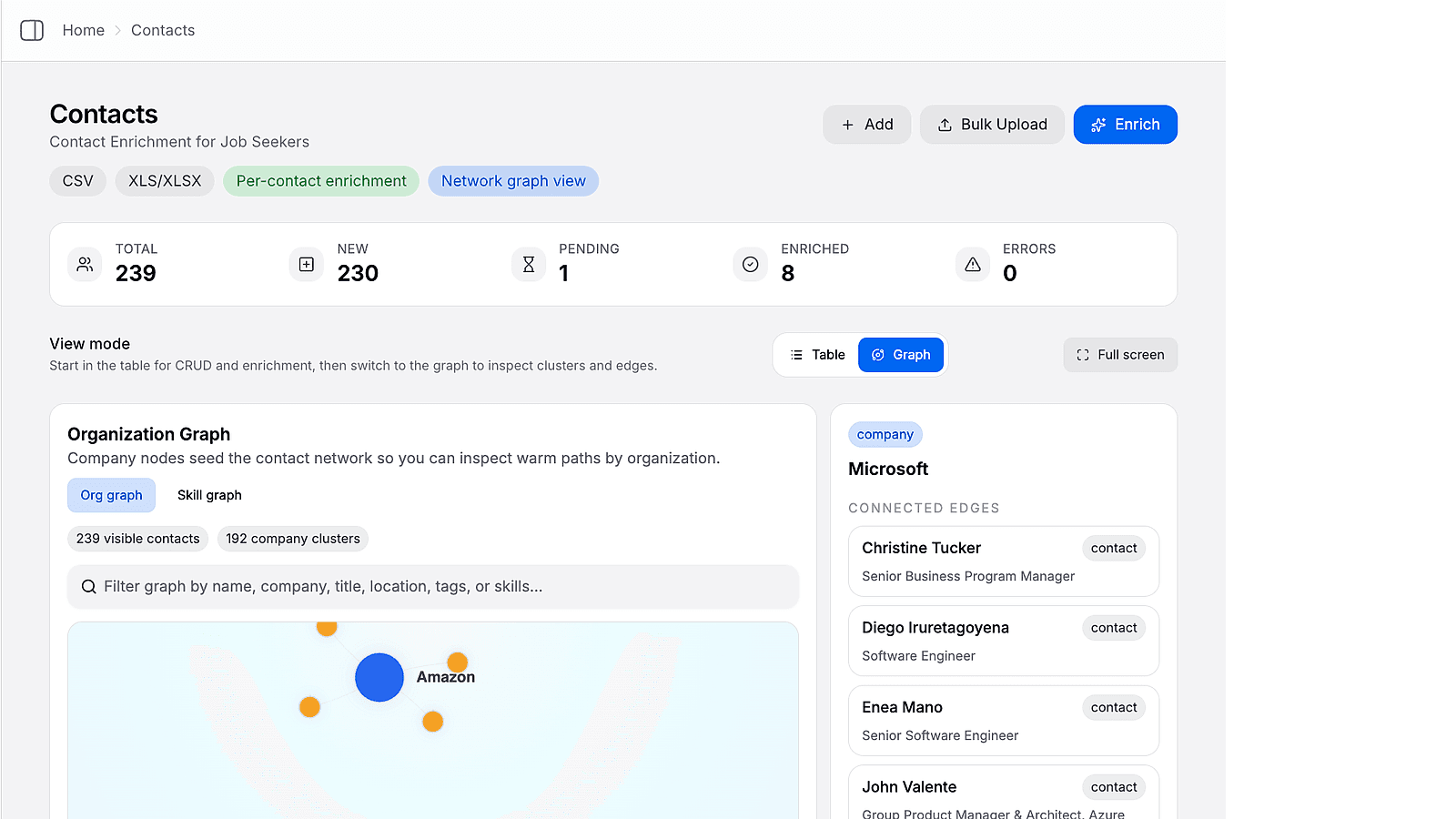
Job-fit analysis helps a seeker understand whether their experience maps to a role. It can expose gaps, translate proof, and suggest stronger positioning.
But fit alone can create a cold search. A role can score well and still be hard to reach. Another role may score slightly lower but sit near a warm path, a relevant contact, or a company where the seeker has context.
Reachability changes priority
Reachability is not a shortcut around merit. It is a signal about where a candidate can create a more human opening.
Useful relationship context can include:
- Known contacts at the company
- Former coworkers connected to the hiring team or function
- Alumni, community, or regional links
- Recent activity that makes outreach timely
- Company pages and listings that can be watched over time
When this context sits beside fit scoring, the product can help prioritize opportunities that are both credible and reachable.
The contact record becomes strategic
A contact is more than a name and email. In a network-aware search, the contact record can carry company context, source history, relationship strength, enrichment results, notes, and next actions.
That makes contacts useful to the compare workflow, the dashboard, and Raven. A contact can help explain why one listing deserves a different next step than another.
Better decisions come from combined signals
The product direction is to combine role fit, resume proof, company context, contact context, and user intent. This gives the job seeker a more practical decision view:
Is this a role I can credibly pursue, and is there a path that makes the pursuit worth prioritizing?
That is the difference between a search driven only by matching and a search driven by strategy.
Product notes
This is a ResumeRavenPro product-method note. It describes how relationship context should be used inside the product and does not claim that any contact will provide a referral or hiring advantage.